Saturday, March 21, 2009

Inductive Cooktops

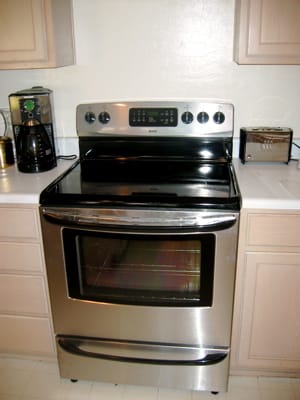
This Choice magazine article gets the science wrong saying Al and Cu will not work with inductive cook tops. It also insists on close proximity. Both are wrong.


The following site covers the Pros and Cons of inductive cooker

  1. By heating only the pan there is low thermal inertia, things get to temperature more quickly
  2. There is less waste of energy, it is claimed it is more efficient than gas.


  3. From our families experience, it has the problem of not working well for blind people who need to feel the heat.
  4. It safer as there are no hot elements to start a fat fire if hot fat spills.


    Pasted from <http://thecoredump.org/images/stove_new.jpg>


Inductive Cooktops

This Choice magazine article gets the science wrong saying Al and Cu will not work with inductive cook tops. It also insists on close proximity. Both are wrong.


The following site covers the Pros and Cons of inductive cooker

  1. By heating only the pan there is low thermal inertia, things get to temperature more quickly
  2. There is less waste of energy, it is claimed it is more efficient than gas.


  3. From our families experience, it has the problem of not working well for blind people who need to feel the heat.
  4. It safer as there are no hot elements to start a fat fire if hot fat spills.


watch or link

Transformers

Summary

Motors and generators can have coils on shaft or casing or both. (both for universal).

Motors switch the field to be the wrong way with commutators.

Induction motors have designer eddy currents to create drag.

Energy is conserved, back torque and EMF with speed. High speed greater voltage.


Energy transforming devices can be compared:


They have different function:


Motors generate force from electricity

Generators make electricity from force

Transformers make electricity from electricity


They use different laws:


The motor effect describes current to produce force F = BilsinTheta


Faraday's Law v=-Dphi/DT describes changing magnetic flux to produce a voltage across a conductor. Either motion of the conductor or changing flux. Current flows if there is a circuit.


Conservation of energy applies to each:


When current flows in a generator, power is transferred, the motor effect resists motion W =Fxd, energy is conserved.


When a motor speeds up the Faradays law explains a back EMF


How do you describe a transformer?


A transformer is an electrically powered electricity generator.

A current in one circuit drives a magnet, that then drives the current in the next circuit .


The wires are drawn showing that electricity can not pass straight through the transformer. The primary is usually on the left or bottom of the diagram. The number of turns is N1. The more turns the stronger the magnetic field.


The core is drawn by a series of parallel lines to represent a laminated core. This core directs the magnetic field from the primary winding to the secondary winding. The iron core is permeable and intensifies the magnetic field inside the iron and reduces it outside therefore it acts as a channel for magnetic field. The energy transformation is electrical- magnetic-electrical.


N2 is the number of coils on the secondary. The voltage change across a transformer is given by


For AC currents. Faraday's law means that transformer time differentiates the input voltage. Having a rapid change in current, causes a voltage spike and spark. This is the principal of a cars spark plugs.


Step up transformers have many turns on the secondary coil. The wires on the secondary are small as the current for a particular power level is less. SUT are used for high voltages in long distance transmission, and in old TV sets, and street lighting.


Step down transformers have few turns on the secondary.

There is greater current in the secondary and the wires are thick to reduce resistive loss. SDT are used to get safe domestic voltage and again for Silicon Digital devices. They are also used for where high currents are needed in welding. Transformers are used to deliver high currents for speakers.


Managing energy losses in transformers.


There is ohmic or resistive energy loss as you can have kilometres of wire conductor in a transformer


The is mechanical vibration loss. The wires in a transformer are squeezed together at high current. This can be heard as transformer buzz. The mechanical vibration limit the matterials used for the core.


The are parasitic eddy currents. This is managed by using lamination to interrupt the eddy.


The is current leakage through the insulation of the wires. This is called dielectric break down. Special matterials are used PEEK and transformer oil.


The major problem of the losses is the increase in temperature leading to run away ohmic heating. Special transformer oil is cycled through the transformer similar to an oil heater. The oil moves through cooling fins, and if the air circulation is not enough fans are connected to force cooling. The oil is designed to expand when heated and so rise and push cool oil through the transformer. In large transformers only metal cores have the thermal conductivity. Transformer oil must withstand high voltages.


Major problems of failure in transformer is material degradation leading to break down. The oil channels can become clogged. Hot spots can cause run away failure. Dr Hill worked on optical fibre temperature sensors for inside transformers and optical fibre voltage sensors. You have sometimes as little as 1 second to shut a transformer down before it explodes.


Frustrated eddy current


Wednesday, March 18, 2009

Sunday, March 15, 2009

More Exam Drill

Homework: Complete 2007 exam (2hrs) for Wednesday. Email me a log of the time spent doing the project.


Question

"Compare DC, AC and Induction motors, and discuss their application"

Step 1: Copy and Highlight key words.
Step 2: Write "Comparison"
Step 3: Write out table, Property, DC, AC, Induction, Comparison
Step 4: Fill in rows: Power in , Commutators, Process, Back EMF eddy current, Application
Step 5: Summary

Question

"Explain Einstein's similtanety"

Similar steps, c constant, inertial frames, lighten bolts on space ship.

Question

"Describe a step down transformer"

Copy and highlight. Draw a diagram.

Wednesday, March 11, 2009

Thursday Lesson

Coached Exam Question.


11111111111111111111111111111
Copy this in your book.

Explain how Einstein used a thought experiment to show that Inertial Frames experience time dilation

Highlight verb and important terms

Note: A thought experiment is one done in your head, Inertial frames means moving frames etc and time dilation.........

Start to answer question with:

Explanation:

First sentence, define or mention important terms. Then state Einsteins postulate, about c and the laws of physics. Then draw bounce diagram and conclude.

This video explains the concept

222222222222222222222222222

Copy and Highlight

Discuss factors that influenced your measurement of g with a pendula

Write

"Discussion:........"

First sentence: Key terms, diagram, and equation.
Talk about mass, effects of location on planet.

333333333333333333333333333333

"Compare Edison and Westinghouse's Power war"

"Comparison:.............

Table of Property/ Edison/ Wesinghouse/ Comparison

Time and Place/ New york 1900/ New York 1900 / Same time and place
Method / DC / AC / Different methods
Distribution/ generators everywhere/ step up- travel- stepdown/ Westinghouse less expensive
Danger/ DC safer / AC Kills you/ Edison was safer.

Summary statement.

44444444444444444444444444

Describe the magnetic field induced at a point half way down a copper tube when a magnet is dropped down it.

"Description: " + Diagram + Lenz law + Right hand wrap + For example

Remember the field oppose entry and exit.


5555555555555555555555555555

Read the Chapter on Induction motors to work out the difference between DC, Universal (AC) , and induction motors




Tuesday, March 10, 2009

Calendar

Search

Search Dr Hill and HSCOnline

Translator

About Me

My photo
I come from a Science family: My father Geoffrey Hill was Australia's first computer programmer on CSIRAC the fourth computer in the world. He is credited with invention of Computer music and the development of “Interprogram” a language before Basic. My PhD is in Atomic and Molecular Physics. I have researched the activated oxygen layer above the ozone layer, and 'Assigned' the world's smallest molecule. At the University of Toronto I researched high power UV lasers. I have specialized in automation in fibre optics. This developed into research in Machine Intellect and Robots. I have enjoyed work as an Explainer with Questacon and my time as a part-time soldier. I currently teach High School Science at Epping Boys’ High.